Dismantling, Temporary Operation and Reinstallation of Hybrid Dry Coolers
Project start
March 2025
Location / Location
Munich
Customer
P8 Architects
Recooler connections
Recooler with maintenance access
Description
As part of the roof refurbishment of the southern head building of Schrannenhalle Munich, the existing HVAC installation – in particular the hybrid dry coolers – had to be temporarily dismantled. Ingenieurbüro Ingo Geib GmbH (IBIG) was responsible for the planning, coordination and technical supervision of the measure – from dismantling and setting up a temporary cooling supply on the ground and site management of the new installation on the roof. The operation of the 1.0 MW water cooled chiller in the basement could be maintained throughout the construction phase, apart from a short, technically unavoidable interruption. After completion of the roof works, the two hybrid dry coolers were recommissioned.
Recooler is connected
Empty roof
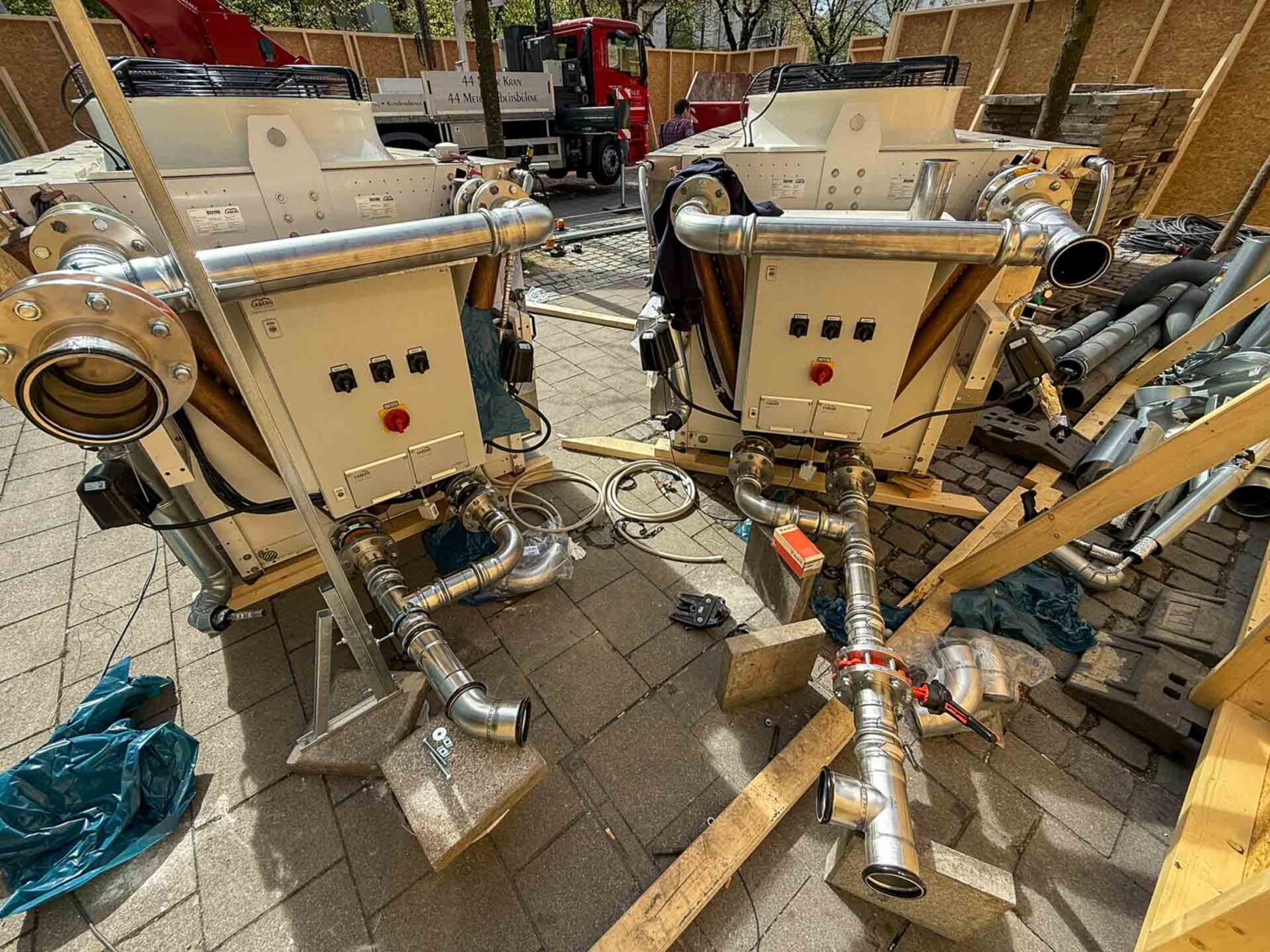
Recooler connection for temporary operation on the ground
Initial situation
The roof of the southern head building required refurbishment. Over the years, technical installations on the roof had become increasingly congested, significantly restricting maintenance and service access – particularly to the hybrid dry coolers serving the water-cooled chiller. In addition, hydraulic and control-related weaknesses existed within the water-glycol circuit, which adversely affected system performance.
Project objective
The primary objective was to maintain the cooling supply as far as possible during the refurbishment works, which took place from May to July, in order to ensure continuous operation of Schrannenhalle – especially the Eataly market and the office areas – without prolonged downtime. At the same time, identified deficiencies were to be permanently rectified and the hybrid dry cooling system technically optimized to ensure stable, efficient and future-proof operation.
Implementation
IBIG surveyed the existing installation to the extent necessary for the project and compared it with the available documentation. Based on this assessment, targeted optimizations were implemented:
Retrofitting of a missing diaphragm expansion vessel in the water-glycol circuit
Hydraulic review and balancing of the condenser pumps
Optimization of the water management of the hybrid dry coolers
Adjustment of the pump start-up control sequence
Correction of setpoints and control parameters
For the construction phase, temporary connections were installed, allowing the dry coolers to operate provisionally at ground level. After completion of the roof works, the units were reinstalled on the roof, followed by renewed hydraulic and control optimization.
The result is a reliable and energy-efficient cooling system with improved maintenance accessibility and optimized hydraulic performance.